


Creating an OT toolbox for kids at home can be a simple way to have helpful sensory and visual supports on hand when your child needs them. You don't need to fill your home with every therapy tool available, either. A small collection of thoughtfully chosen resources can make everyday routines, transitions and sensory needs a little easier to manage.
For our family, we’ve created a little drawer where we keep all of our sensory supports. This has been a gamechanger for one of my kids in particular, who has a lot of difficulty with organising herself. She now knows where to go when she needs a support, and I can also direct her to the drawer when she’s feeling overwhelmed or I can tell she’s starting to “lose it”.
An at-home OT toolbox can look different for every family. The key is choosing tools that suit your child's individual needs and incorporating them into familiar parts of the day.
Our Top Occupational Therapy tools and sensory products for kids at home
1. Ear Defender Noise Protection Ear Muffs
Busy environments, unexpected sounds and everyday household noise can sometimes feel overwhelming for children who are sensitive to sound.
In my home, our top noise triggers at home are the blender (my kids love smoothies but they don’t like the noise involved in making them!), the vacuum, and our squeaky dryer.
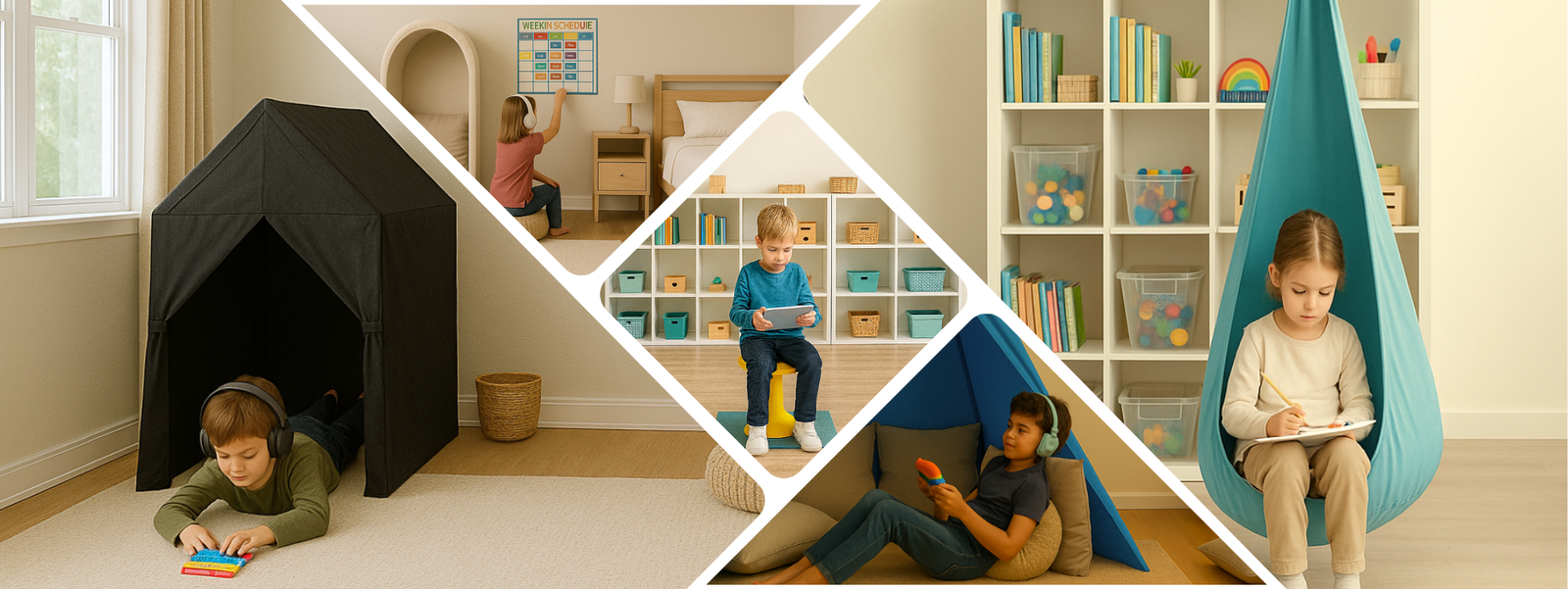
Ear defenders can be a useful addition to an OT toolbox, providing children with an option for reducing the impact of surrounding noise when they need a quieter sensory environment.
Keep them somewhere easily accessible so your child can use them when appropriate. Whether that's during a noisy household activity, while out and about, or when they need some quiet time. Some families like to keep more than one pair at hand, so there’s one for home and one for out and about, or for school or kinder, for example.
Giving children access to sensory tools can also help them become more aware of what supports them and when they might like to use those supports.
2. Time Timer Visual Countdown Clocks and Timers
Transitions can be tricky for many children, particularly when it's time to stop a preferred activity and move on to something else.
Time Timers provide a visual representation of passing time, helping children see how much time remains rather than relying solely on verbal reminders. My daughter recently commented that her new timer helps her to stay on track and not get distracted. This blew me away, because she is only 6 years old!
Times like our Time Timer Plus range are handy because they feature a carry handle, making them easy to move around the house and take with you when needed. In my home, because I have 3 young children who like to meddle with everything, we keep an 8 inch timer on our fridge (they’re magnetic so easy to attach!), as well as a smaller mod timer for use around the house.
You can also use removable sticky hooks placed high on the wall to position your timer somewhere visible but out of reach of little hands. This can be particularly useful when you want your child to be able to see the timer during a routine without being distracted by touching or moving it.
Try using your timer for everyday activities such as:
- Getting ready in the morning (this is a big one in my house!)
-
Finishing screen time
-
Getting ready to leave the house
-
Mealtimes
-
Bath time
-
Bedtime routines
3. Visual Routine Chart
Visual supports can be a fantastic way to make everyday routines more predictable and easier to understand.
A visual routine chart allows children to see what is happening now, what comes next and what they can expect throughout a routine.
One of the benefits of a flexible visual routine chart is that you can change it as your child's needs change, or you move between activities. Simply use new pieces of white paper and write or draw the activities you need for that particular day or routine, and swap them in and out as required.
For example, a morning routine might include:
-
Get dressed
-
Eat breakfast
-
Brush teeth
-
Pack school bag
-
Put shoes on
-
Leave the house
Rather than repeatedly giving verbal instructions, the visual chart can act as a consistent reference point that your child can check throughout the routine.
4. Sensory Swings
A sensory swing can be a wonderful addition to a home sensory space when you have an appropriate place to install and use one safely. We have 3 sensory swings set up on our outside porch, because if your kids are anything like mine, they need to have the same thing as their siblings. FOMO is strong!!
Movement can provide valuable sensory input for some children, and a sensory swing can offer a dedicated space for movement, calming or simply taking a break.
Every child responds differently to movement, so it's important to consider your child's individual sensory needs and follow the manufacturer's installation, weight and safety guidelines. An Occupational Therapist can help with choosing a swing if you’re not sure where to start.
A sensory swing can become part of a broader sensory space at home, alongside other calming and regulating resources.
5. Pop-Up Dark Den Sensory Tent
Sometimes children need a space where they can step away from the stimulation of a busy household.
A dark den can create a cosy, low-light environment where children can take some quiet time when they need a break from their surroundings.
It can be used as part of a sensory room or simply as a designated spot for quiet play, reading (with a suitable light) or downtime.
The idea isn't necessarily to use the den whenever a child becomes overwhelmed. Instead, it can become a familiar and inviting part of the home that your child knows is available when they want some quieter time. This can (hopefully) help them learn to regulate themselves and sometimes avoid getting to meltdown point.
6. Morning Routine Chart
Mornings can involve a lot of steps, and remembering each one can be challenging for some children.
A morning routine chart provides a visual way to work through the morning routine, helping children know what needs to happen and what comes next.
Having the same visual sequence each morning can help create predictability and encourage children to become more independent with familiar tasks over time.
You can pair a morning routine chart with a Time Timer to provide both visual information about what needs to happen and how much time is available.
My kids get a real kick out of moving the magnetic tiles over to the ‘done’ area as they work through the tasks, making it more motivating for them to engage in the morning routine.
Building Your Own OT Toolbox at Home
You don't need to purchase every sensory product available to create a useful OT toolbox.
Start by thinking about the situations your and your child find challenging at home. Is it transitions? Getting ready in the morning? Too much noise? Moving between activities? Finding a quiet space?
From there, it’s easier to choose tools that address those everyday situations. For example:
For transitions:
- Time Timer Plus + visual routine chart
For noisy environments:
- Ear defenders
For movement needs:
- Sensory swing
For quiet time:
- Dark den
For morning independence:
- Prepp’d Kids morning routine chart / visual routine chart + time timer
The best OT toolbox is one that fits naturally into your family's everyday life and gives your child practical supports they can access when needed.
Create an OT Toolbox That Works for Your Family
An OT toolbox for kids at home doesn't have to be complicated. A few carefully chosen visual, sensory and routine-based tools can become useful parts of your child's day.
From visual timers and routine charts to ear defenders, sensory swings and cosy quiet spaces, these resources can help you create a home environment that supports your child's individual needs.
Remember that every child is different. What works brilliantly for one child may not be right for another, so consider your child's preferences and sensory needs when choosing tools for your home. If you need any help or advice, our experienced therapy team is here to help.
Explore our range of OT and sensory tools for kids and start building a toolbox that works for your family.





Leave a comment (all fields required)